
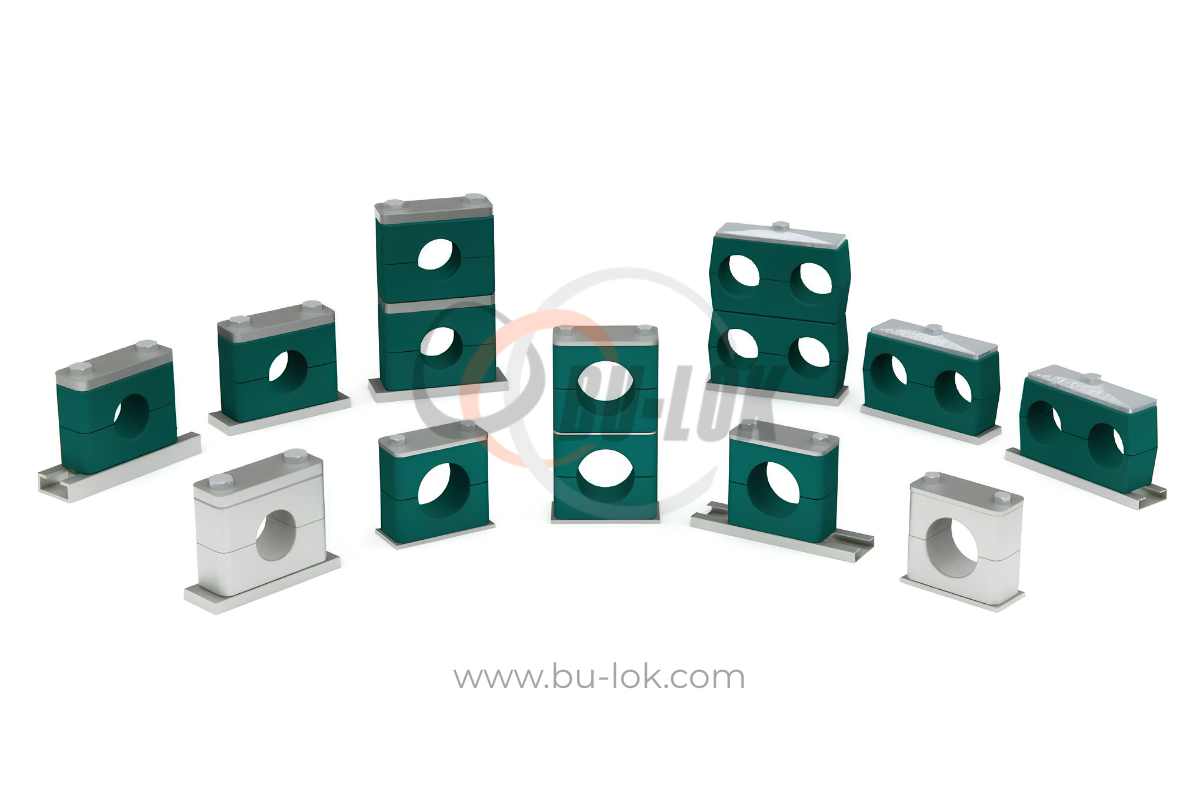
What Is a Polypropylene Pipe Clamp?
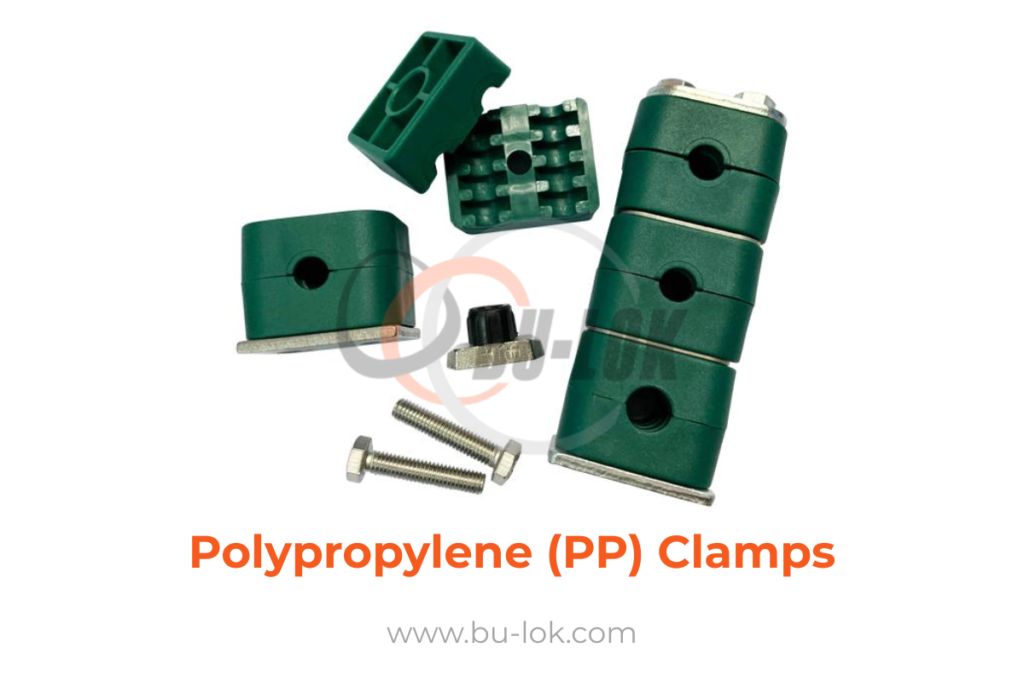
A polypropylene pipe clamp is a tube support clamp whose body is moulded from polypropylene (PP), the thermoplastic that has become the industry standard for clamp bodies. When an engineer specifies a clamp without naming a special material, it is almost always a PP clamp — recognisable by its familiar green colour.
PP became the default for three reasons working together: it resists a broad range of oils, fuels, acids and chemicals, it damps vibration and noise effectively, and it is the most economical clamp body for high-volume use. For the majority of indoor and general industrial lines, no other material is needed.
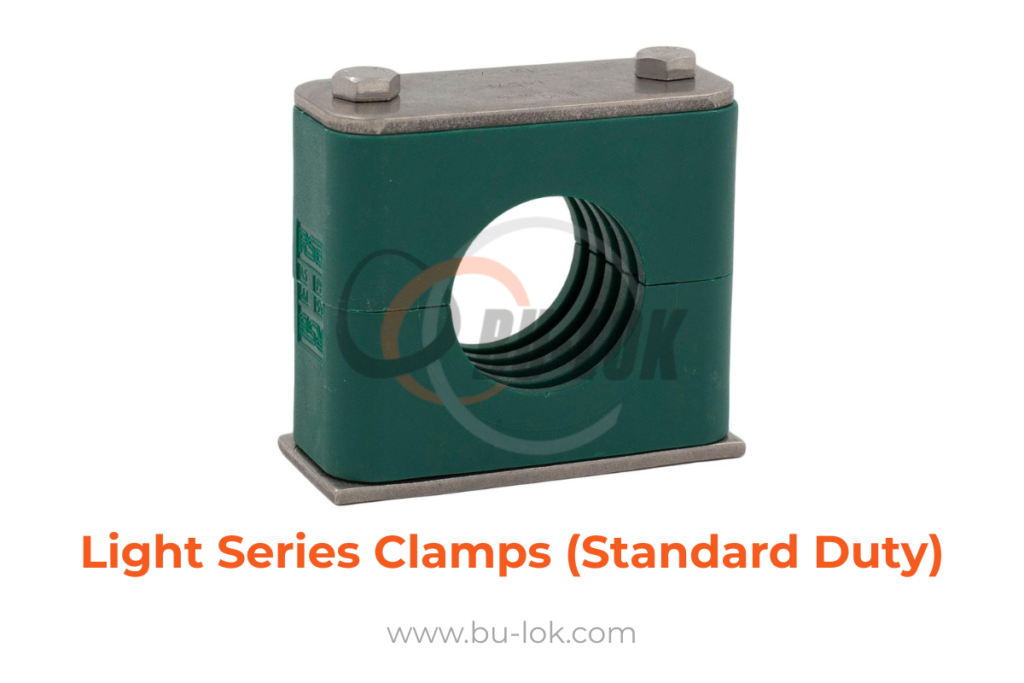
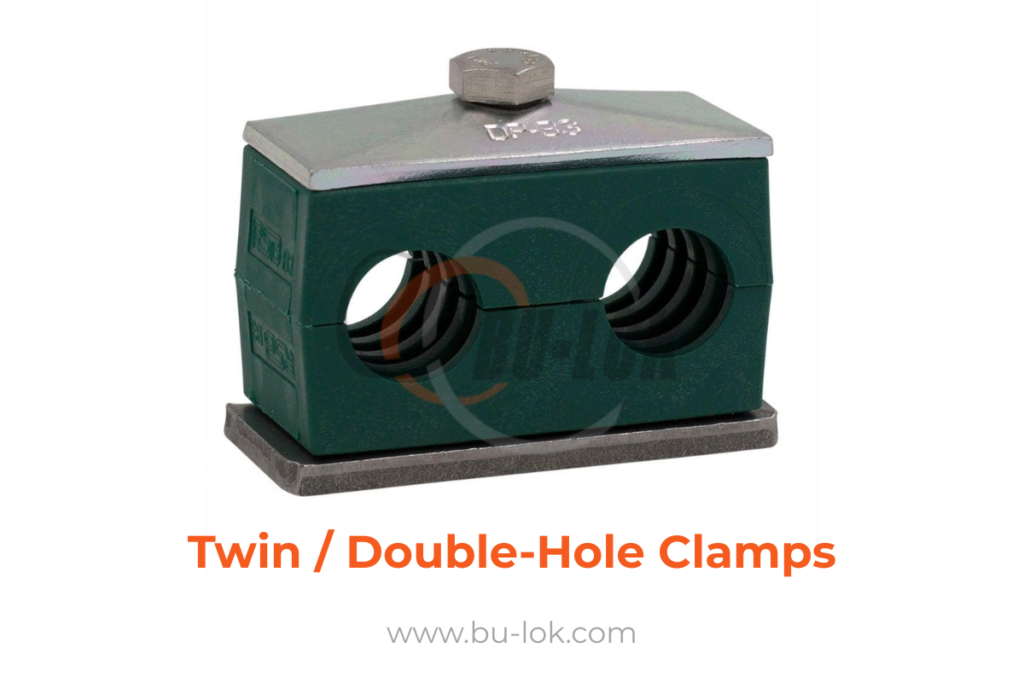
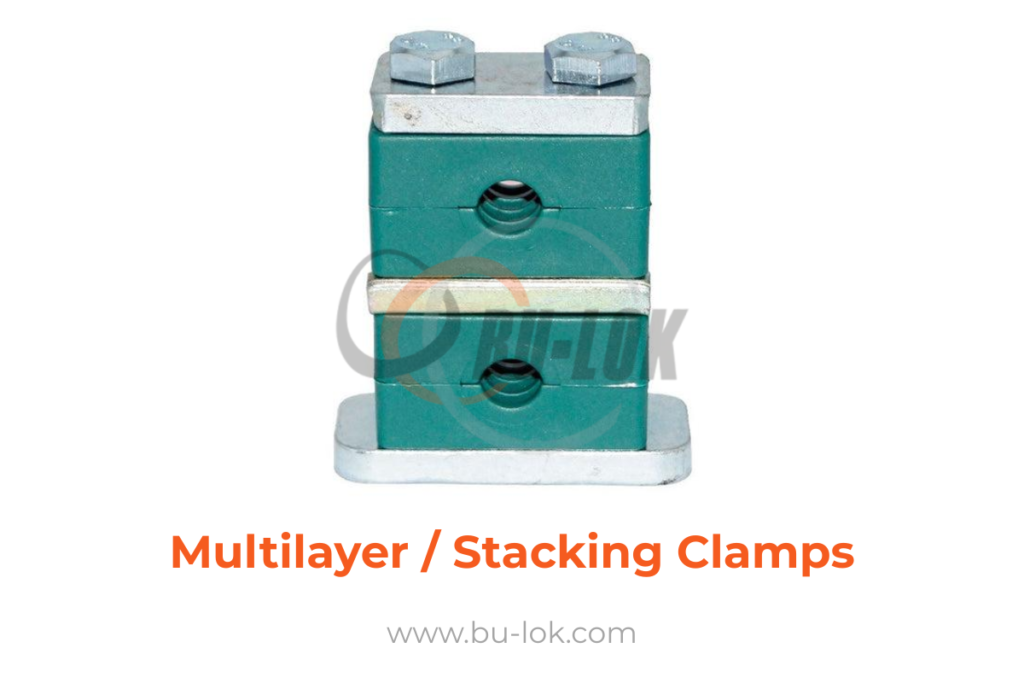
Like every DIN 3015 clamp, a polypropylene clamp is built from two clamping halves, a weld or mounting plate, a cover plate and a hex bolt. The PP halves close around the tube and grip it to full circumference, holding it steady while absorbing the pulsation that travels through a pressurised line.
Because the body follows DIN dimensions, a PP clamp drops into the same layout and rail as polyamide, aluminium and stainless clamps — so PP is used everywhere it is sufficient, and other materials only where they are specifically required.
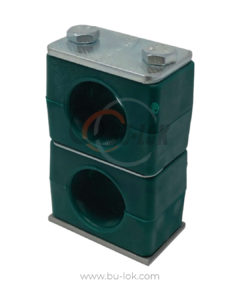
Why Polypropylene Is the Standard Clamp Material
PP earns its position as the default body because it balances performance and cost better than any alternative for ordinary routing:
- Broad chemical resistance — it withstands a wide range of hydraulic oils, fuels, coolants, acids and alkalis, covering most industrial fluids without a material upgrade.
- Excellent vibration damping — its slight flexibility absorbs pulsation and noise, protecting the tube and its fittings from fatigue.
- Lowest cost — for high-volume clamping, PP delivers the best value per clamp.
- Electrical insulation — as a non-conductor, it isolates the tube electrically where that is required.
- Lightweight — it adds minimal weight to a panel, skid or machine.
- Corrosion-proof body — being plastic, the body itself never rusts; only the hardware grade needs to suit the environment.
The result is a clamp that handles the everyday majority of hydraulic, pneumatic, instrumentation and chemical lines reliably and economically.
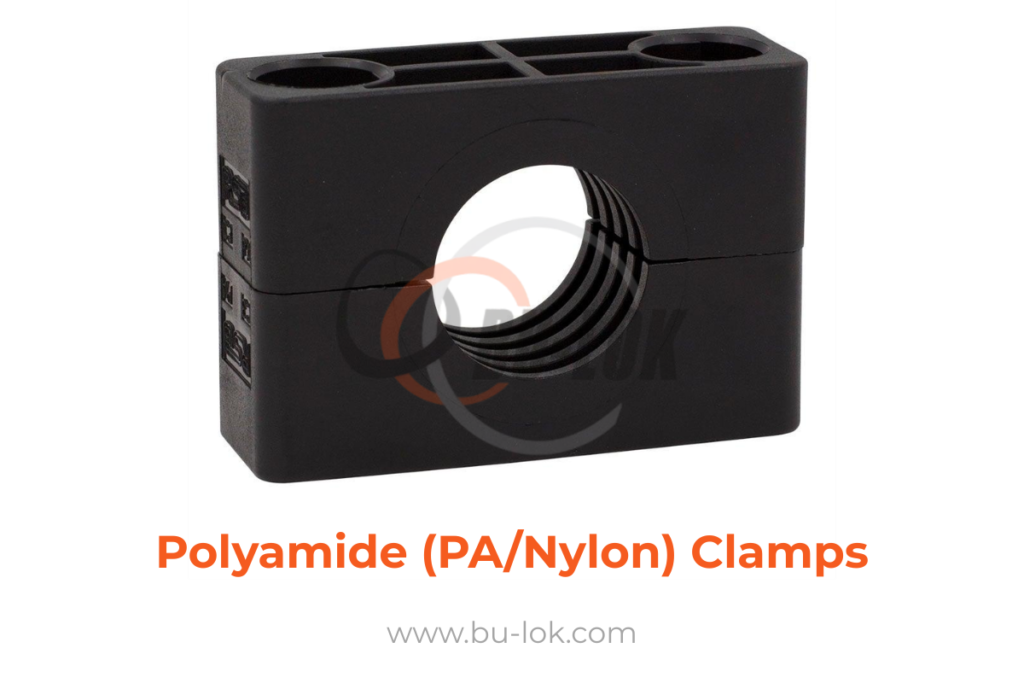
Polypropylene (PP) vs Polyamide (PA / Nylon): Which Plastic Body?
The two plastic clamp bodies are polypropylene and polyamide. Choosing between them is the most common material decision in clamp selection, and getting it right avoids both under- and over-specifying.
Factor | Polypropylene (PP) | Polyamide (PA / Nylon) |
Colour | Green | Black |
Chemical resistance | Excellent (broad range) | Good |
Temperature range | Standard | Higher |
Impact / mechanical strength | Good | Higher — tougher |
Abrasion resistance | Good | Higher |
Moisture absorption | Very low | Higher (absorbs moisture) |
Relative cost | Lowest | Higher |
Best for | General routing, chemical exposure, economy | Hot, high-impact, mobile-machinery duty |
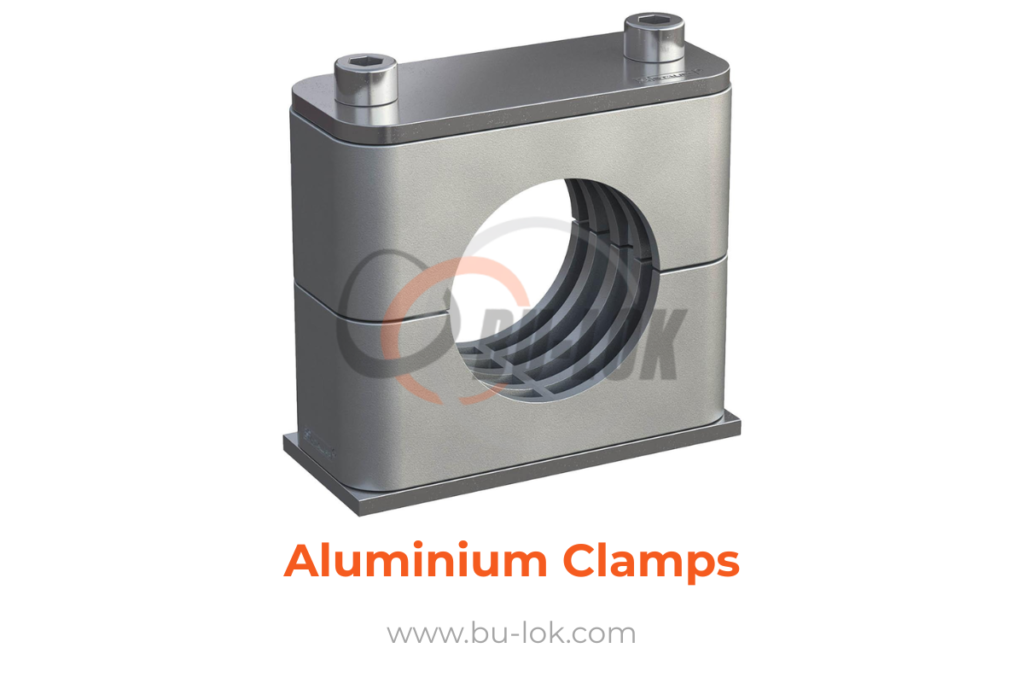
Choose polypropylene for general routing, strong chemical resistance and the best cost — the right call for most lines. Step up to polyamide when the clamp faces higher temperatures, heavy impact and shock, or abrasive conditions, such as on mobile and earthmoving equipment. If the line runs hotter than plastic allows, is in a fire-safety zone, or must be conductive, move to an aluminium body instead.
Bu-Lok Polypropylene Pipe Clamps at a Glance
Bu-Lok manufactures PP clamps across the full DIN 3015 range, so one supplier covers the bulk of any piping or hydraulic project.
Specification | Bu-Lok Polypropylene Pipe Clamp |
Standard | DIN 3015 Part 1 (light), Part 2 (heavy), Part 3 (twin) |
Body material | Polypropylene (PP) — green |
Tube OD range | 6 mm to 219 mm (1/4″ to 8″) |
Cover & weld plate | Mild steel (zinc trivalent / A3C) or Stainless Steel 304 / 316 |
Hex bolt | M6 to M30, in steel or stainless |
Temperature range | Approx. −30 °C to +90 °C (confirm per application) |
Key properties | Broad chemical resistance, vibration damping, economy, insulating |
Working pressure | Up to 6000 PSI (≈420 bar), per series and configuration |
Equivalent to | STAUFF, Parker, Swagelok PP clamp series |
Minimum order | 50 pieces; bulk and custom volumes supported |
Built to DIN tolerances, Bu-Lok PP clamps are direct fit-for-fit replacements for imported PP clamps and combine freely with PA, aluminium and stainless clamps on the same job.
Chemical and Temperature Performance
The reason PP dominates general routing is its chemical resistance. It stands up to most hydraulic oils, mineral oils, fuels, water-glycol fluids, many acids and alkalis, and a wide range of process chemicals — which is why it is trusted in chemical, water-treatment and general-process plant as well as hydraulics.
On temperature, PP comfortably handles the everyday operating range of most hydraulic and pneumatic lines, roughly −30 °C to +90 °C in typical use. Where a line runs consistently hotter, polyamide extends the range, and an aluminium body extends it further still. For very low temperatures or specific aggressive media, our engineering team can confirm whether PP is suitable or whether a different body is the safer specification.
Selection tip: PP is the right default unless a specific condition — high heat, heavy impact, fire safety, conductivity, or an unusually aggressive chemical — pushes you to PA, aluminium or stainless. Specifying PP where it is sufficient keeps project cost down without any loss of reliability.
Applications of Polypropylene Pipe Clamps
PP clamps are the workhorse of clean, economical, vibration-free routing. Bu-Lok PP clamps are used across:
- General hydraulic systems — power packs, presses and machine hydraulics where standard conditions apply.
- Instrumentation and control panels — neat, low-cost routing of sensing and signal tubing.
- Pneumatic and lubrication lines — holding air and oil lines steady against everyday vibration.
- Chemical and process plant — resistance to a wide range of acids, alkalis and process fluids.
- Water treatment and utilities — corrosion-proof bodies for water, glycol and utility lines.
- Machine tools and automation — tidy, economical tube and hose management on frames and rails.
- General manufacturing — the default clamp across the majority of indoor industrial piping.
How to Specify a Polypropylene Pipe Clamp
Three decisions define the right PP clamp. Bu-Lok’s engineering team can confirm each.
- Confirm PP is sufficient. Check the line is within PP’s temperature range, carries fluids PP resists, and has no fire-safety or conductivity requirement. If all true, PP is the economical choice.
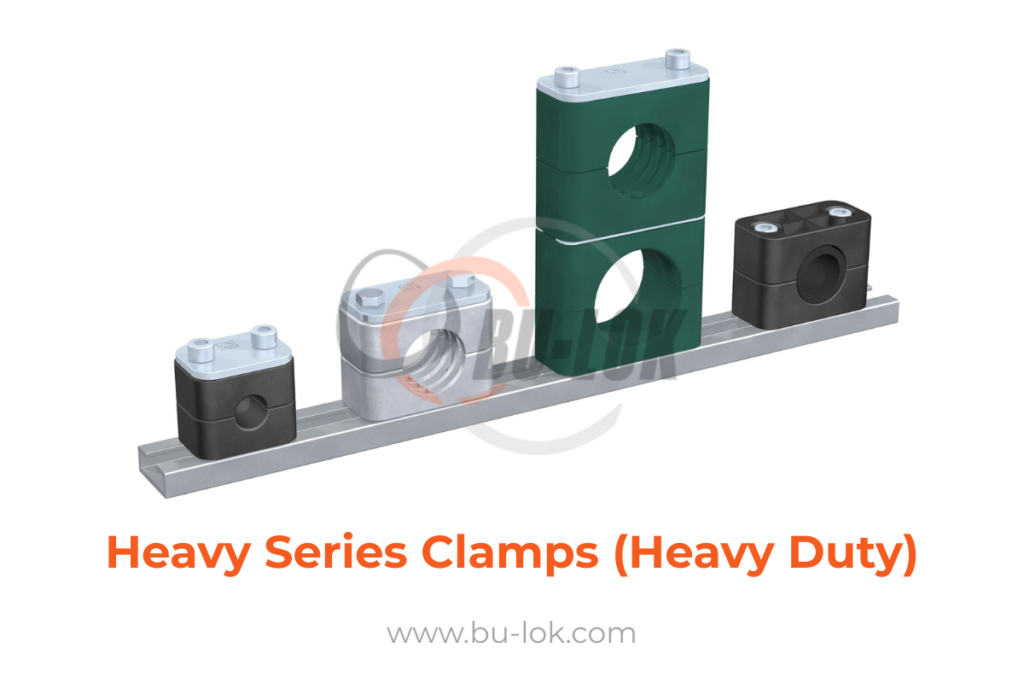
- Choose the series. Match DIN 3015 Part 1 (light) for low-to-medium pressure, Part 2 (heavy) for high pressure and large bore, or Part 3 (twin) for paired lines — PP is available across all three.
- Select the hardware grade. Pair with zinc-plated steel for standard dry environments, or stainless 304/316 where the surrounding environment is corrosive — the plastic body never rusts, so only the hardware grade needs matching to the conditions.
Sizing tip: Size the clamp to the tube’s outer diameter (OD), not the bore. An exact OD match grips evenly; an oversized clamp lets the tube vibrate and fret.
Why Choose Bu-Lok for Polypropylene Pipe Clamps
Bu-Lok delivers imported-grade PP clamp quality, manufactured in India, at a competitive price and short lead time.
- Full DIN 3015 range in PP — light, heavy and twin series, from 6 mm to 219 mm OD, the backbone of any clamp order.
- True import equivalents — dimensionally interchangeable with STAUFF, Parker and Swagelok PP series, with no redesign.
- High-volume capacity — consistent moulding quality and stock for the large quantities PP clamps are bought in.
- In-house manufacturing control — consistent DIN tolerances, material certificates and batch traceability.
- Mixed-material supply — PP, PA, aluminium and stainless clamps from one source, so you specify each exactly where it belongs.
- Global export and engineering support — supplying the Middle East, Europe, Africa and Southeast Asia, with hands-on sizing and cross-referencing.
When your project needs reliable, economical clamps for the majority of its lines, Bu-Lok’s polypropylene clamps keep both cost and schedule under control.