
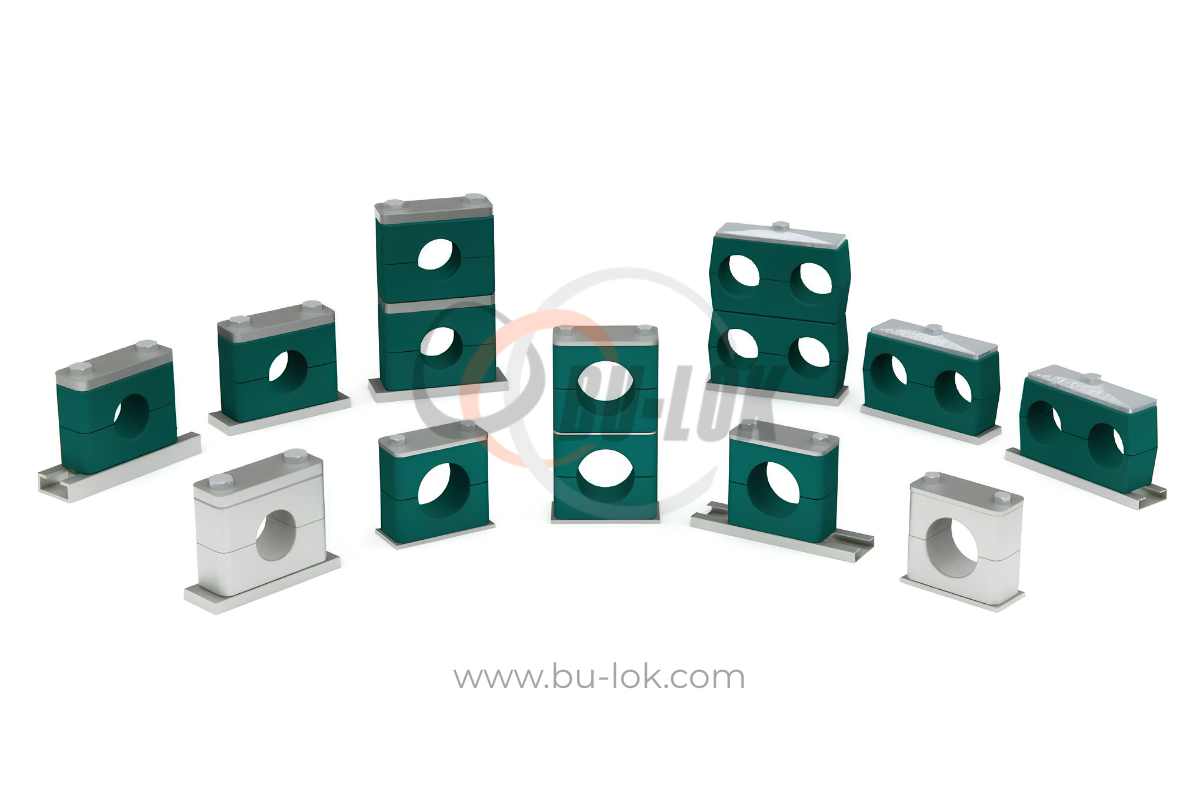
What Is a Twin Tube Clamp?
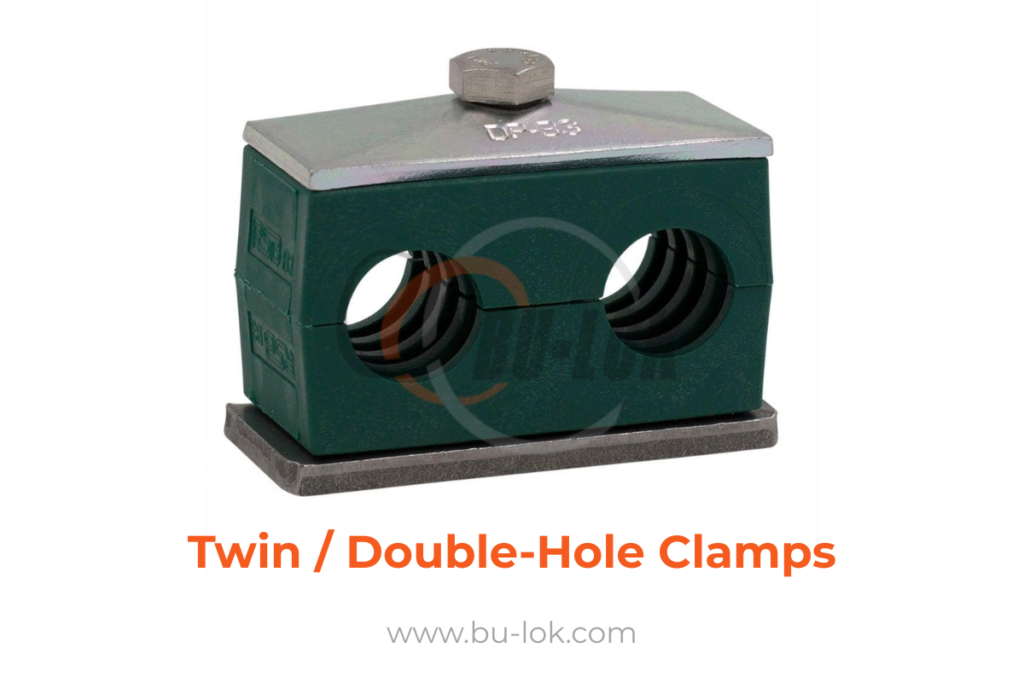
A twin tube clamp — also called a double tube clamp, double-hole clamp or twin series clamp — is a pipe support clamp that grips two parallel tubes side by side within one body. Instead of mounting two separate clamps, an engineer fits a single twin clamp that secures both lines at once.
Built to the DIN 3015 Part 3 twin series standard, it works on the same principle as every DIN clamp: two clamping halves close around the tubes, a weld or mounting plate anchors the assembly, and a cover plate with a hex bolt draws everything tight. The difference is the body — it carries two bores rather than one, so both tubes are clamped to full circumference with a single fastener.
The purpose of a twin clamp is density and tidiness. Where two lines run in parallel — a pressure-and-return pair on a hydraulic circuit, two instrument lines, or a supply-and-drain set — a twin clamp holds them at a fixed, controlled spacing, prevents them from rubbing against each other, and keeps the run neat. It does this while using half the mounting hardware and half the structure space of two single clamps.
Twin Clamp vs Two Single Clamps: Which Is Better?
When two tubes run parallel, you can fit two single clamps or one twin clamp. For genuinely parallel lines, the twin clamp usually wins on space, weight, time and cost.
Factor | Twin Tube Clamp | Two Single Clamps |
Mounting points | One | Two |
Panel / rail space | Compact, fixed spacing | Wider, variable spacing |
Installation time | Faster — one fastener | Slower — two fasteners |
Line-to-line spacing | Controlled by design | Must be set manually |
Weight & part count | Lower | Higher |
Best for | Two parallel lines, tight layouts | Lines on different paths or spacings |
Choose a twin clamp when two tubes of the same diameter run parallel along the same path — the most common case in hydraulic pressure/return pairs, manifolds and skids. Use single clamps when the lines diverge, sit at different spacings, or are different diameters that no standard twin body accommodates. For dense panels and mobile equipment where every millimetre counts, the twin clamp is the default choice.
Bu-Lok Twin Tube Clamps at a Glance
Bu-Lok manufactures the complete DIN 3015 Part 3 twin series, so a single supplier covers every parallel-line position on your layout.
Specification | Bu-Lok Twin Tube Clamp |
Standard | DIN 3015 Part 3 — twin / double series |
Configuration | Two parallel bores in one clamp body |
Tube OD range | 6 mm to 76.1 mm (1/4″ to 2½″) |
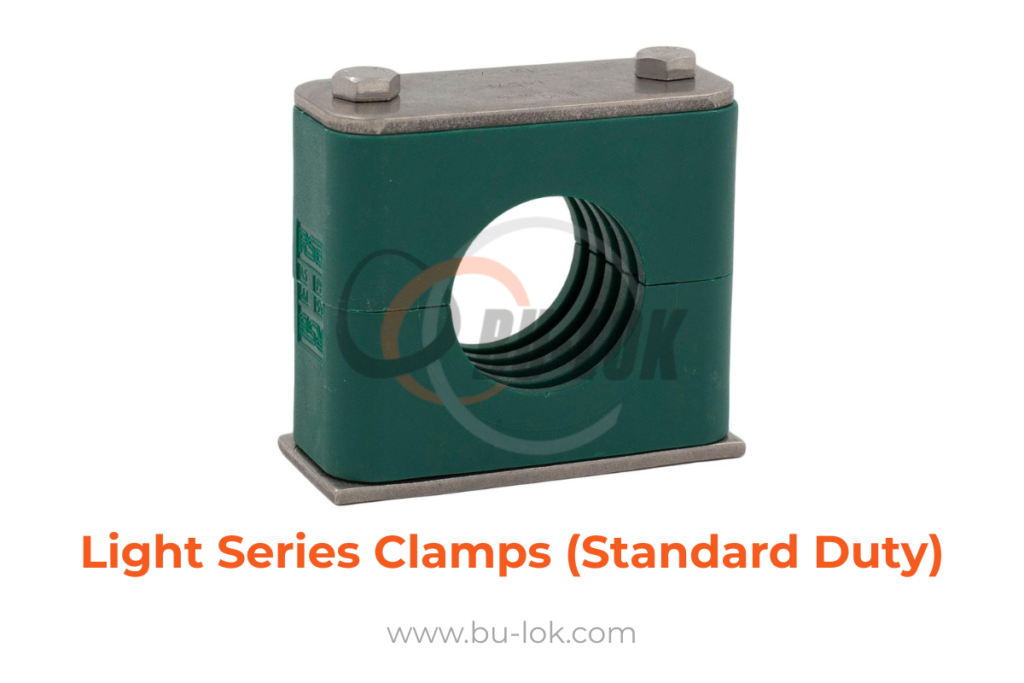
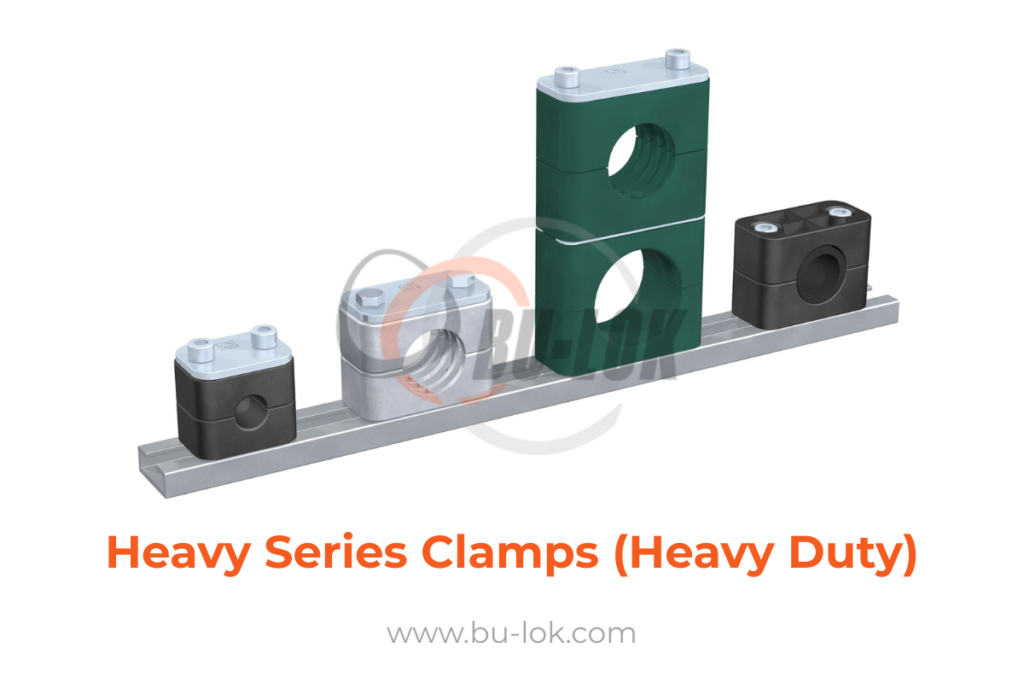
Clamp body | Polypropylene (PP), Polyamide (PA / nylon), Aluminium |
Cover & weld plate | Mild steel (zinc trivalent / A3C) or Stainless Steel 304 / 316 |
Hex bolt | M6 to M12, in steel or stainless |
Body colours | PP — green, PA — black, Aluminium — silver |
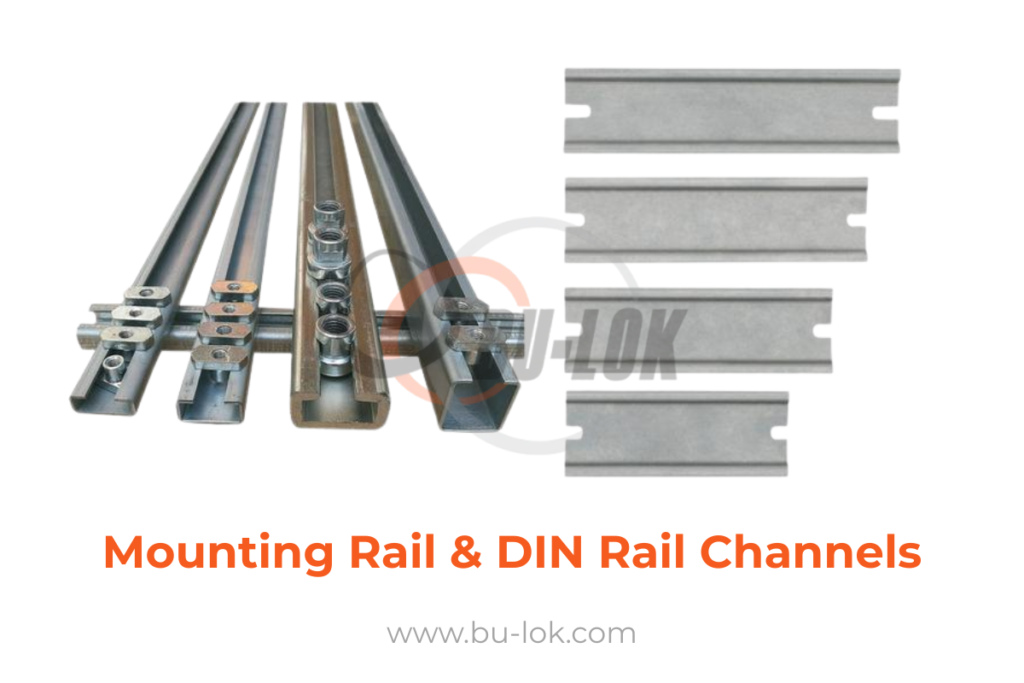
Mounting | Weld plate, bolt-on plate, or DIN mounting rail |
Equivalent to | STAUFF, Parker, Swagelok twin series clamps |
Minimum order | 50 pieces; bulk and custom volumes supported |
Made to original DIN tolerances, Bu-Lok twin clamps drop straight into existing DIN layouts and rails alongside single, light and heavy clamps without redesign.
Twin Clamp Sizes and Pairings
Twin tube clamps are organised into clamp groups, where each group holds a matched pair of tubes of the same outer diameter. Standard twin clamps carry two equal-diameter lines; non-equal pairings can be supplied as a custom configuration.
Bu-Lok stocks twin clamps across the standard range of outer diameters, including:
6 · 8 · 10 · 12 · 15 · 16 · 18 · 20 · 22 · 25 · 28 · 30 · 32 · 38 · 42 · 48.3 · 50 · 60.3 mm (larger sizes on request)
The smaller groups suit paired instrumentation and control tubing; the larger groups handle paired hydraulic and lubrication lines. If your drawing pairs two different diameters or a non-standard OD, our engineering team will confirm the correct twin configuration and supply it.
Sizing tip: Measure each tube’s outer diameter (OD) and confirm both lines are the same size before specifying a standard twin clamp. For two different diameters, ask about a custom twin body rather than forcing a mismatched pair into one bore.
Body Materials for Twin Clamps
Like all DIN clamps, the twin body material governs temperature, chemical and fire performance. Bu-Lok offers three engineered options:
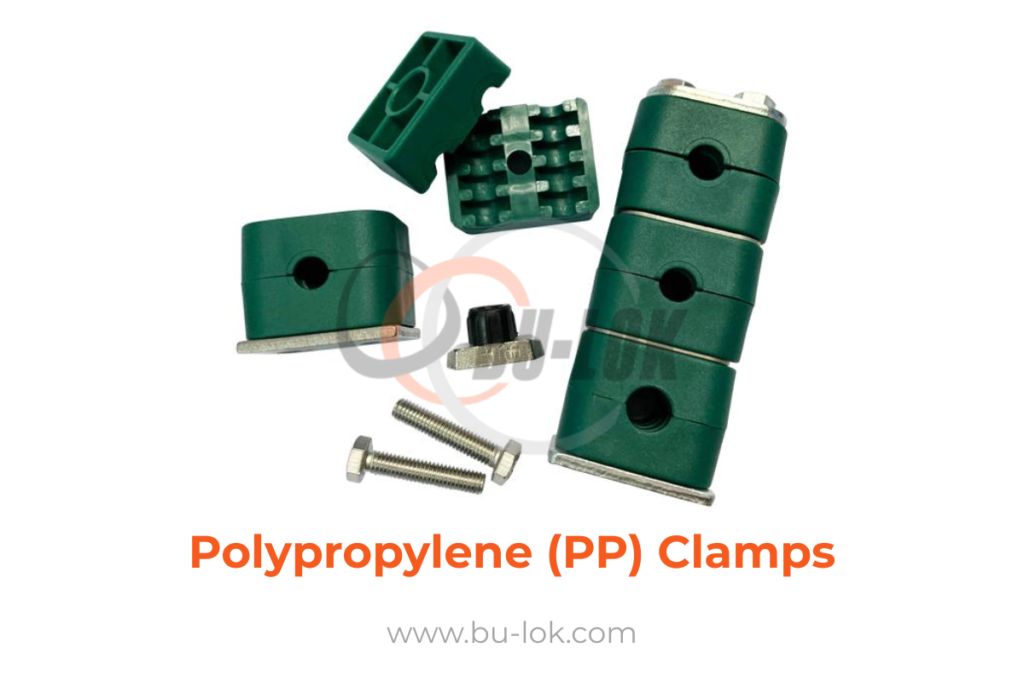
Polypropylene (PP) is the standard, best-value choice for paired general routing — good chemical resistance and vibration damping at the best price. Identified by its green colour.
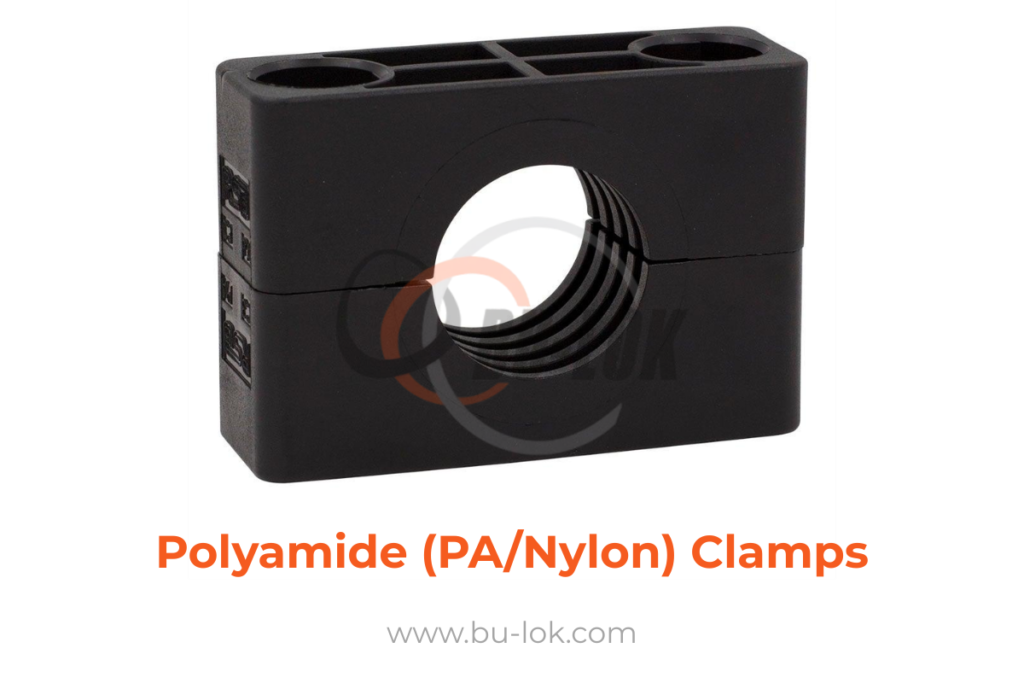
Polyamide (PA / nylon) is the upgrade for higher temperature, greater impact strength and the constant shock of mobile and earthmoving hydraulics, where paired lines take repeated load cycles. Identified by its black colour.
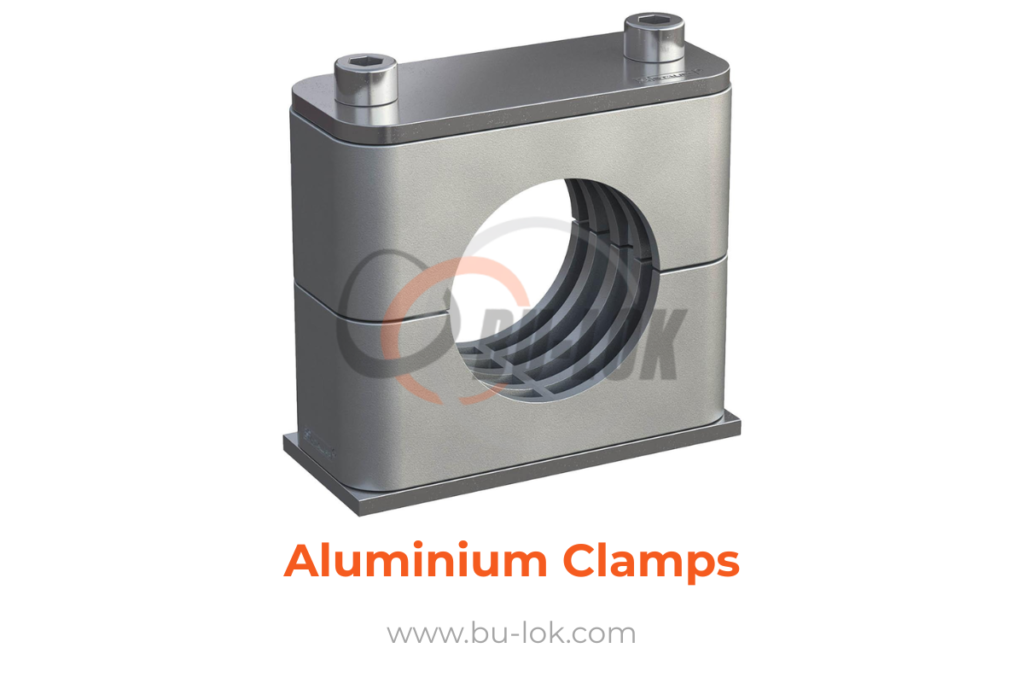
Aluminium is specified where a non-combustible, conductive or high-temperature twin clamp is mandatory — engine bays, offshore decks and fire-critical zones. Identified by its natural silver finish.
For hardware, zinc-trivalent mild steel suits standard environments, while Stainless Steel 304 or 316 is essential for marine, offshore, washdown and chemical service.
Applications of Twin Tube Clamps
Twin clamps shine wherever two lines run together and space is tight. Bu-Lok twin series clamps are used across:
- Hydraulic pressure-and-return pairs — clamping the feed and return lines of a circuit together at fixed spacing.
- Mobile and construction equipment — dense hydraulic routing on excavators, loaders and cranes where panel space is minimal.
- Skid-mounted and packaged units — compact, repeatable clamping of paired process and utility lines.
- Control and instrumentation panels — neat side-by-side routing of paired sensing and signal tubing.
- Pneumatic and lubrication systems — holding supply-and-return air or oil lines steady as a managed pair.
- Machine tools and automation — tidy two-line management on frames and rails without doubling mounting points.
- Marine and offshore auxiliary lines — stainless twin clamps for paired lines in salt-air environments.
How Twin Tube Clamps Are Installed
Twin clamps install on the standard DIN principle, with both lines seated together:
- Fix the base. Weld or bolt the mounting plate to the structure, or snap the clamp onto a DIN mounting rail for a weld-free build — one base now serves two lines.
- Seat both tubes. Lay both parallel tubes into the lower clamp half, then fit the upper half over them.
- Add the cover plate and run the single hex bolt through into the weld plate.
- Tighten once. Draw the bolt down until the halves close fully around both tubes — a single fastener now grips both lines to full circumference.
- Space along the run. Repeat at the recommended interval to prevent sag and resonance, exactly as with single clamps but at half the part count.
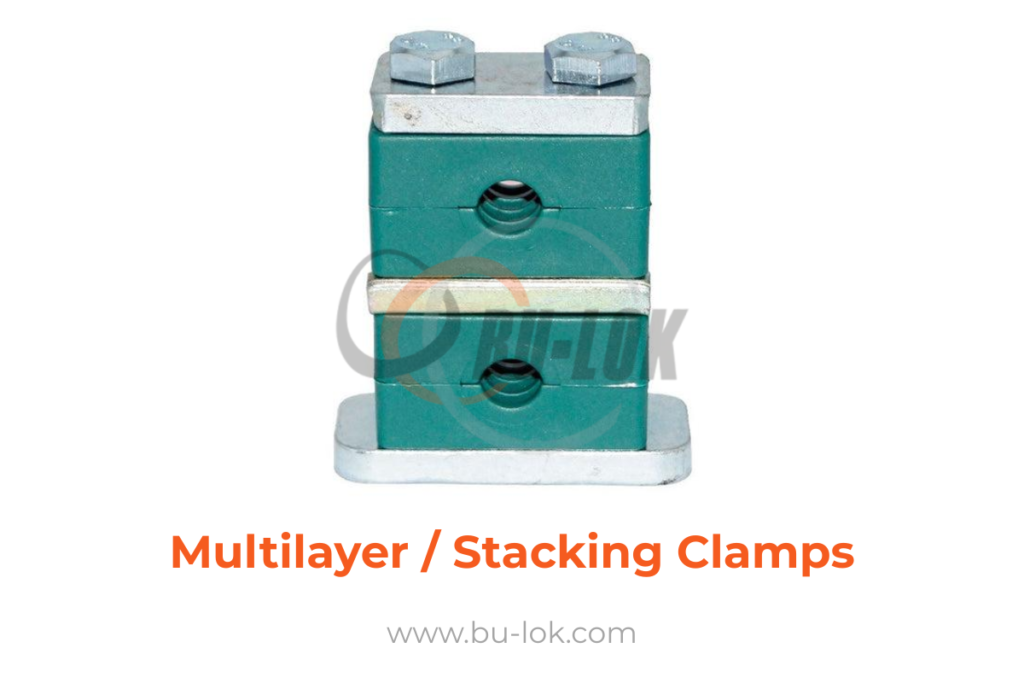
For more than two parallel lines, twin clamps stack vertically on a single rail using longer stacking bolts, building a compact multi-line manifold that stays serviceable.
Why Choose Bu-Lok for Twin Tube Clamps
Bu-Lok delivers imported-grade twin clamp quality, manufactured in India, at a competitive price and short lead time.
- Complete twin series in one place — paired ODs across the standard range in PP, PA and aluminium, with steel or stainless hardware.
- True import equivalents — dimensionally interchangeable with STAUFF, Parker and Swagelok twin series, so no redesign is required.
- Custom pairings — non-equal-diameter and special-spacing twin bodies built to your drawing.
- In-house manufacturing control — consistent DIN tolerances, material certificates and batch traceability.
- Stainless 304 / 316 capability — for the marine, offshore and chemical work that most local suppliers cannot serve.
- Global export and engineering support — supplying the Middle East, Europe, Africa and Southeast Asia, with hands-on help on sizing and cross-referencing.
When your layout pairs two lines and space is at a premium, Bu-Lok’s twin clamps keep the run tidy and the project on schedule.