
What Is a Polyamide Tube Clamp?
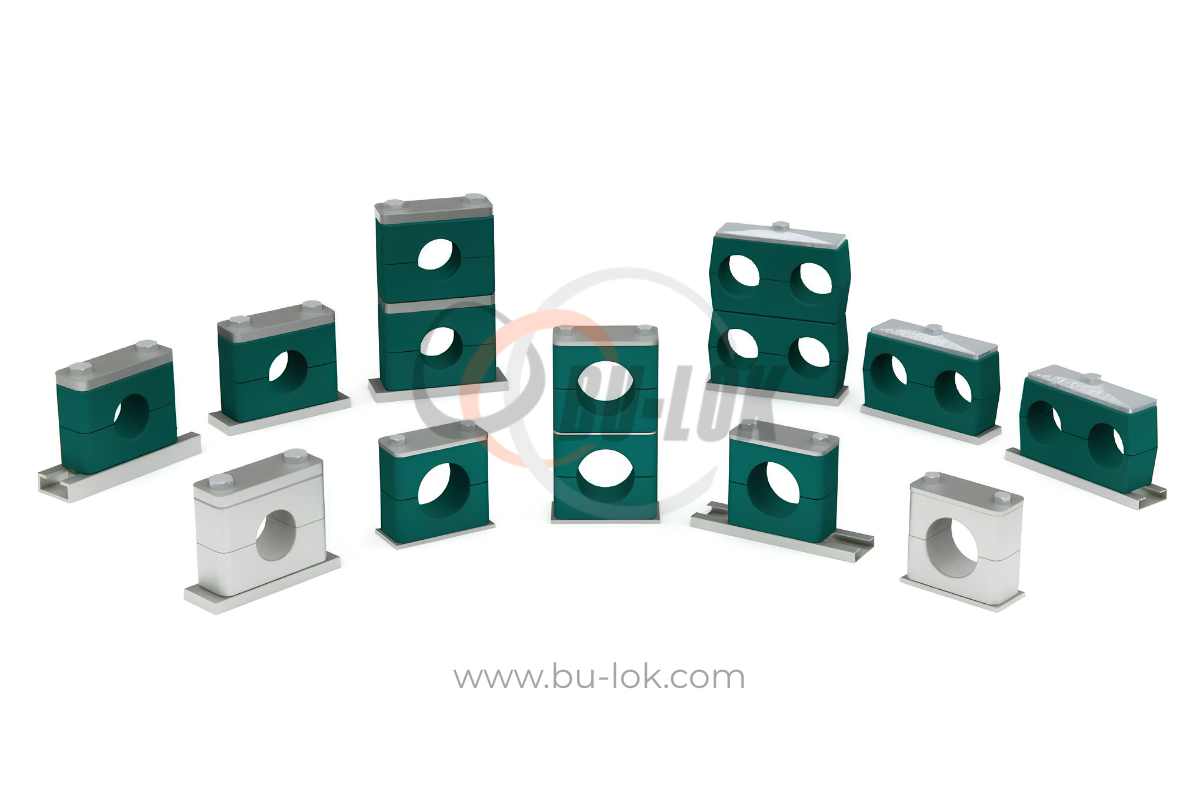
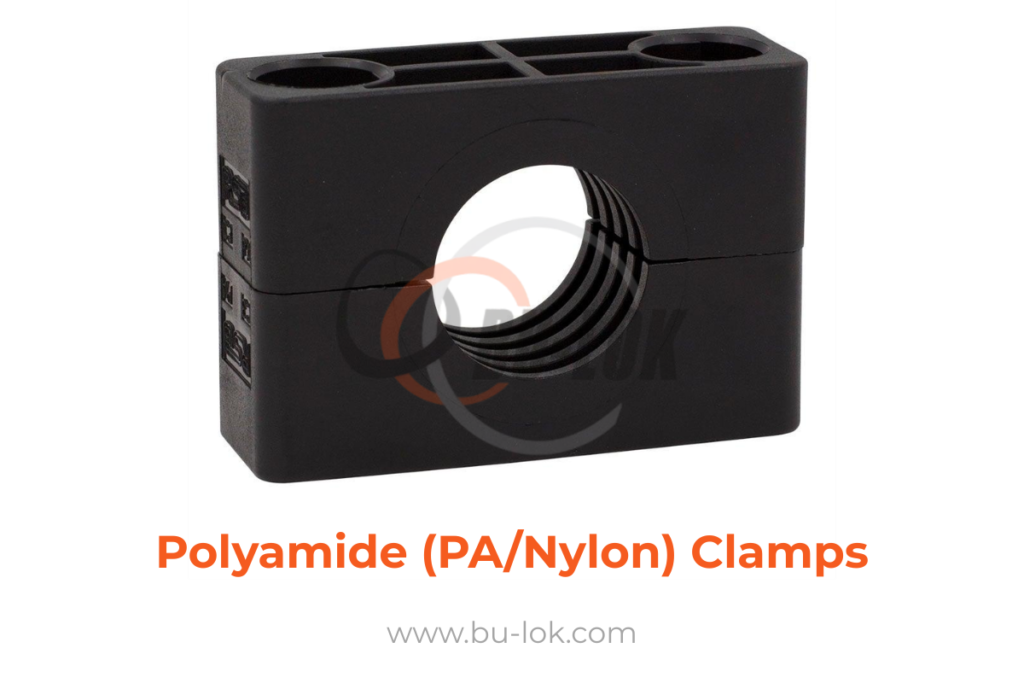
A polyamide tube clamp is a tube support clamp whose body is moulded from polyamide (PA) — the engineering plastic better known as nylon. It does the same job as any DIN 3015 clamp, gripping a tube to full circumference and damping vibration, but it is built to take more punishment than a standard polypropylene clamp. It is recognised by its black colour.
Polyamide is the upgrade body. Where polypropylene is the economical default for general routing, polyamide is specified when the clamp must withstand higher temperatures, heavy mechanical impact, constant vibration or abrasive surroundings — the conditions found on mobile and off-highway equipment. PA’s toughness, strength and wear resistance let it survive duty cycles that would fatigue a softer body.
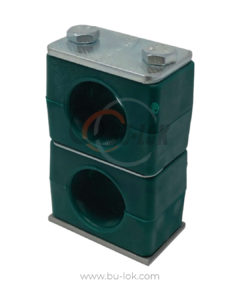
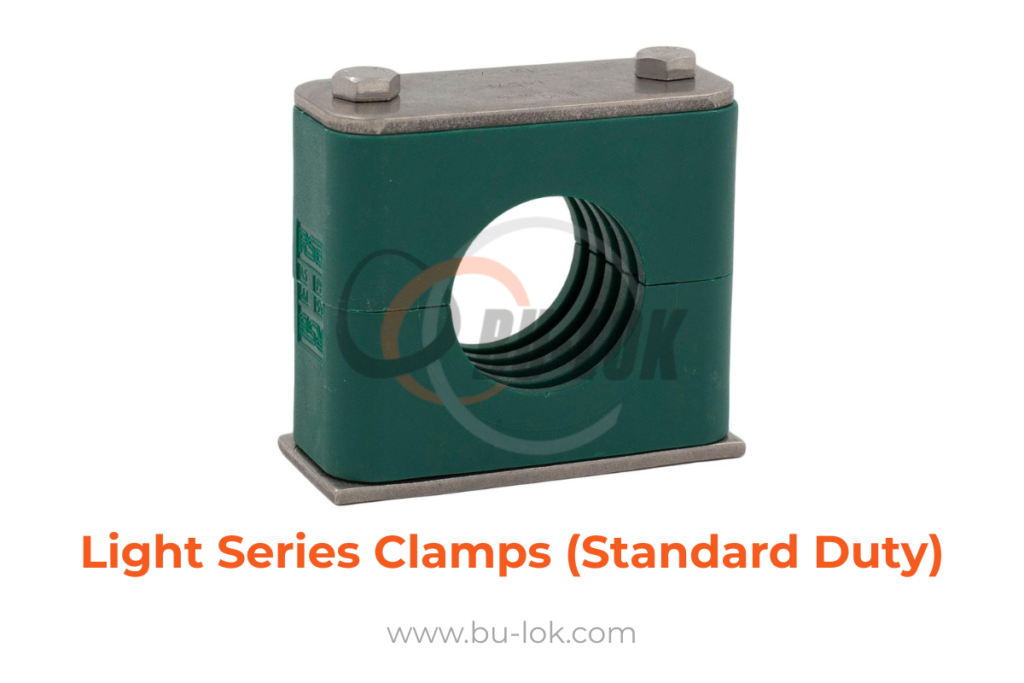
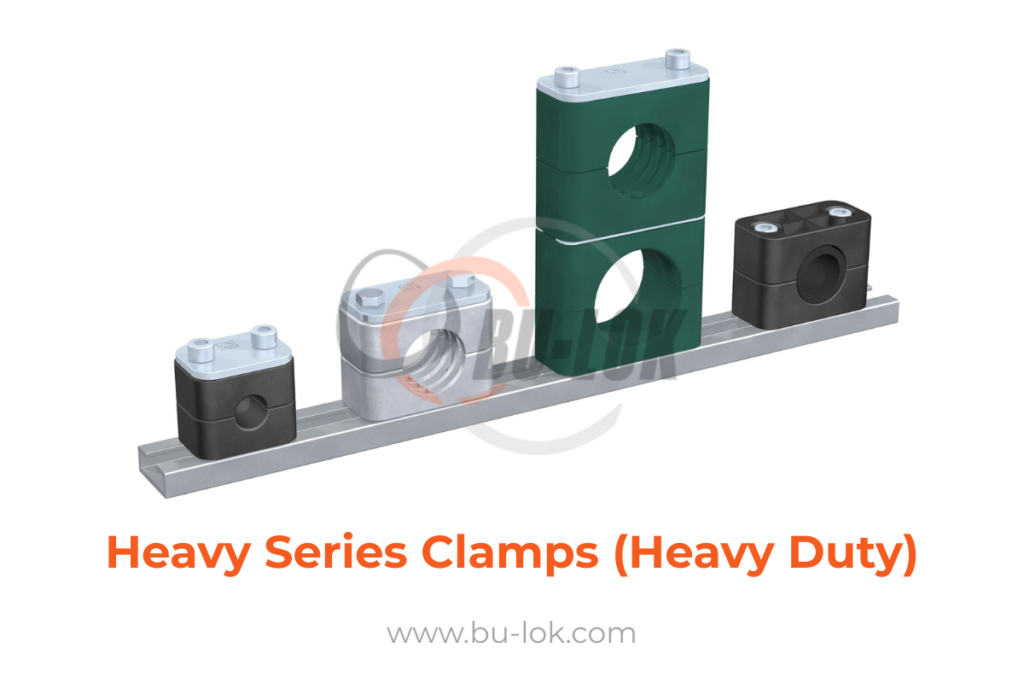
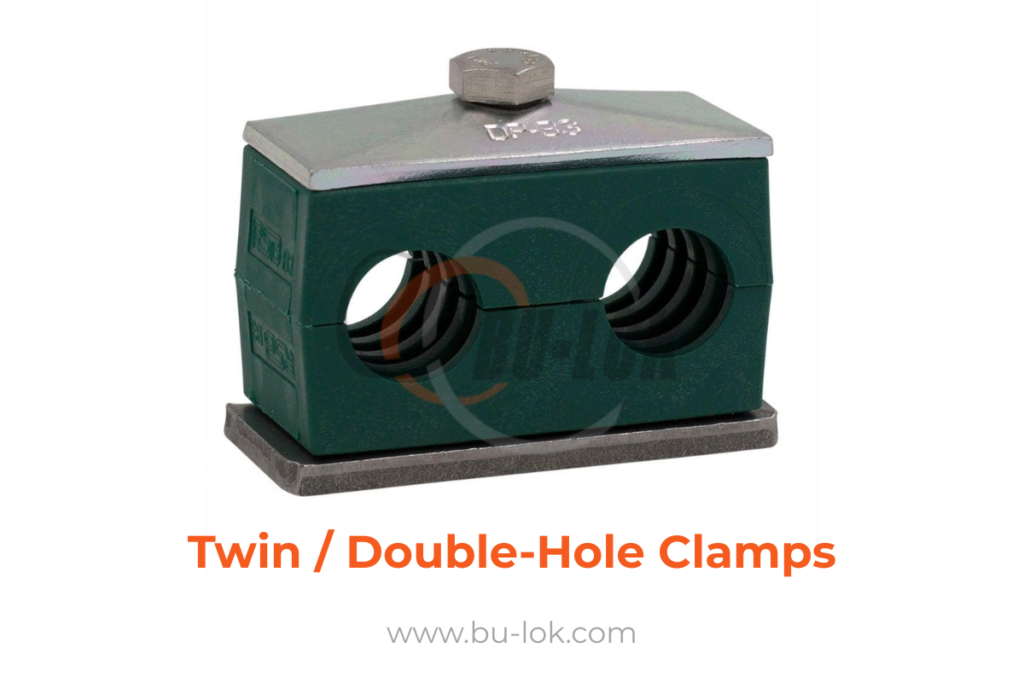
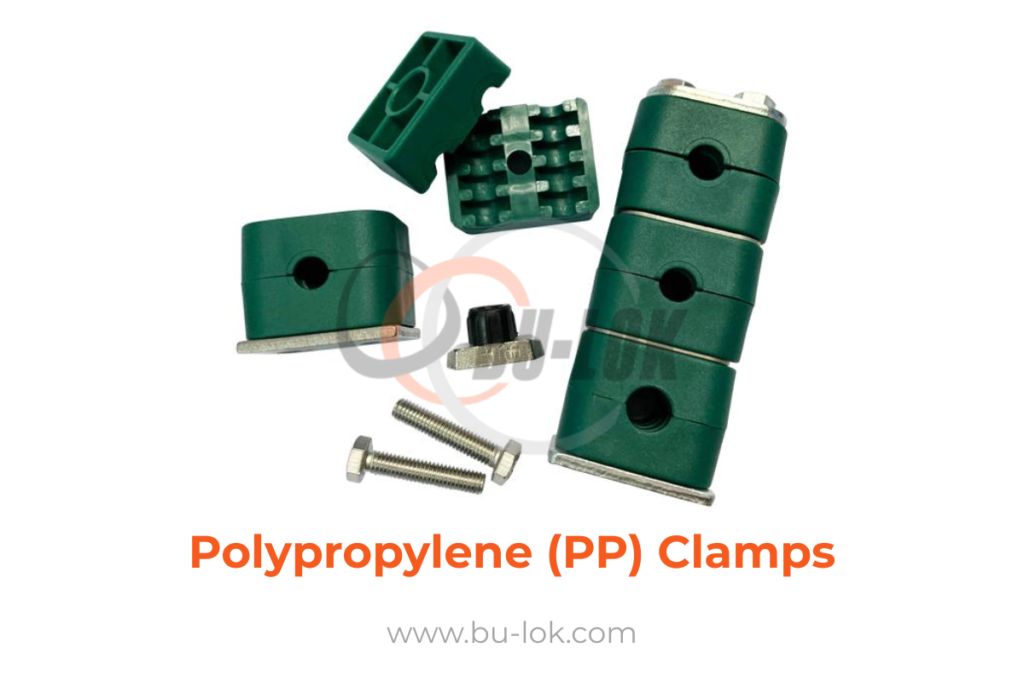
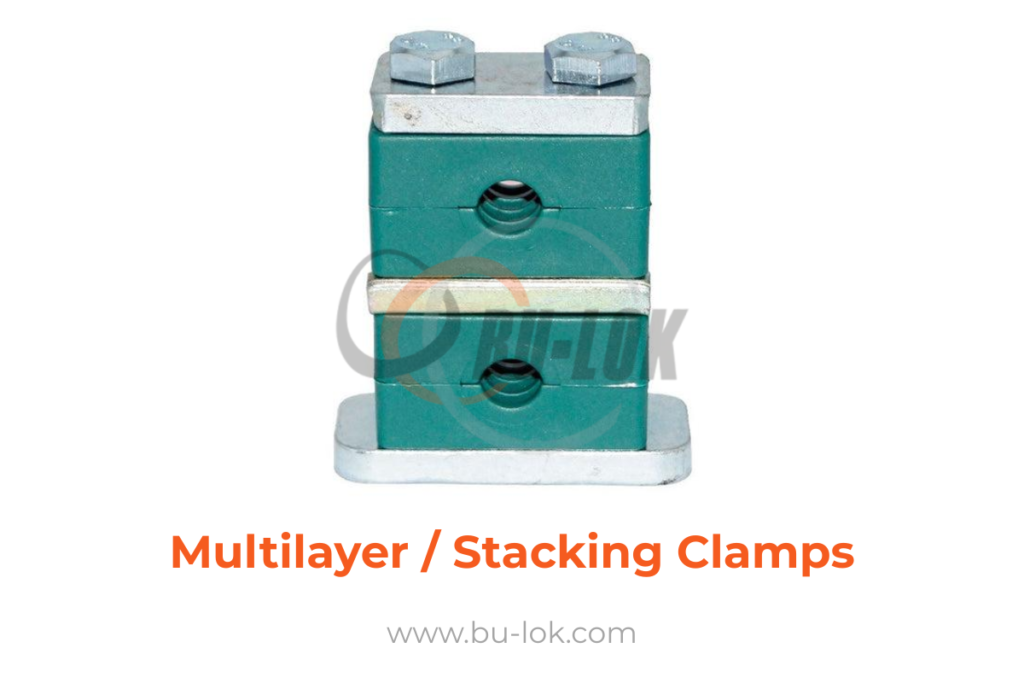
Like every DIN clamp, a polyamide clamp is built from two clamping halves, a weld or mounting plate, a cover plate and a hex bolt. Because the body follows DIN dimensions, a PA clamp drops into the same layout and rail as polypropylene, aluminium and stainless clamps, so engineers use PA only where its extra strength is needed and standard PP elsewhere.
Why Polyamide Is the High-Strength Clamp Body
Polyamide earns its place wherever a tougher, more heat-tolerant clamp is required:
- High mechanical strength — it resists deformation under load, holding the tube firmly even under heavy clamping force and shock.
- Excellent impact resistance — it absorbs knocks and sudden loads without cracking, ideal for mobile and site equipment.
- Higher temperature tolerance — it operates beyond the range of polypropylene, suiting hotter hydraulic and lubrication lines.
- Strong abrasion and wear resistance — it stands up to grit, debris and rubbing in harsh outdoor environments.
- Good resistance to oils and fuels — it performs well against hydraulic oils, mineral oils, greases and hydrocarbons.
- Vibration endurance — it withstands continuous high-frequency vibration and load cycling without fatigue.
The result is a clamp that thrives in the toughest plastic-clamp applications — the heavy, dirty, hot and high-vibration work that defines mobile hydraulics.
Polyamide (PA / Nylon) vs Polypropylene (PP): When to Upgrade
The choice between the two plastic bodies is the most common material decision in clamp selection. Here it is framed from the polyamide side — when the extra performance of PA is worth its higher cost.
Factor | Polyamide (PA / Nylon) | Polypropylene (PP) |
Colour | Black | Green |
Mechanical / impact strength | Higher — tougher | Good |
Temperature tolerance | Higher | Standard |
Abrasion / wear resistance | Higher | Good |
Chemical resistance | Good (excellent vs oils/fuels) | Excellent (broadest range) |
Moisture absorption | Higher (hygroscopic) | Very low |
Relative cost | Higher | Lowest |
Best for | Hot, high-impact, abrasive, mobile duty | General routing, chemical exposure, economy |
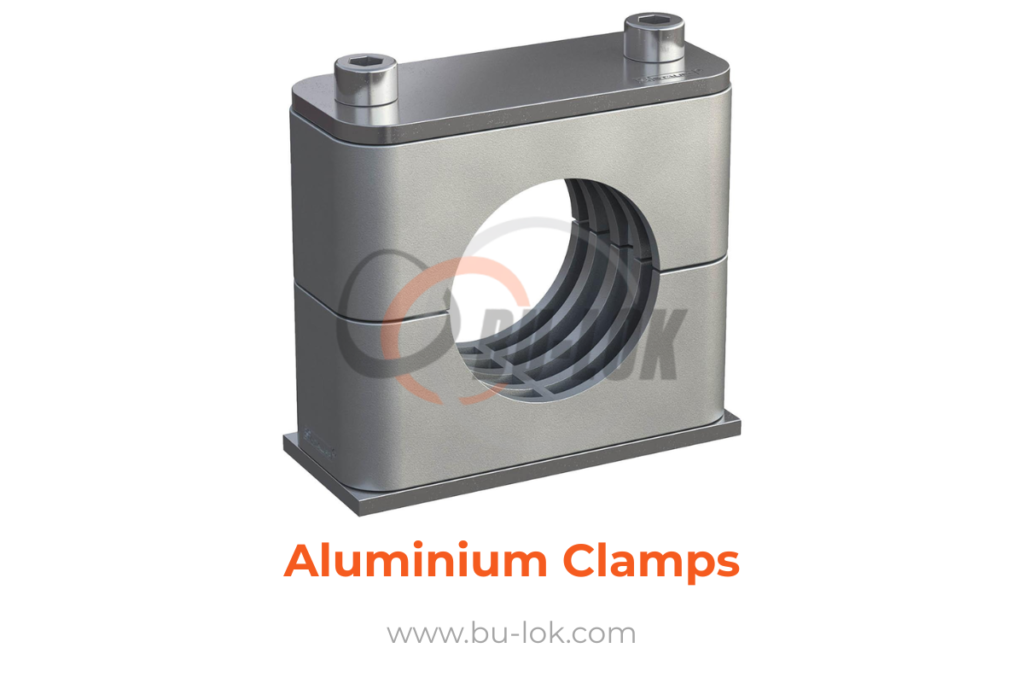
Choose polyamide when the clamp faces higher temperatures, heavy impact, continuous vibration or abrasive conditions — the norm on excavators, loaders, crushers and other mobile machinery. Stay with polypropylene for general routing and the broadest chemical resistance at the lowest cost. If the line is hotter than plastic allows, in a fire-safety zone, or must be conductive, move to an aluminium body; for severe corrosion, marine or hygienic service, move to stainless steel.
Bu-Lok Polyamide Tube Clamps at a Glance
Bu-Lok manufactures PA clamps across the full DIN 3015 range, so one supplier covers every high-strength position on your layout.
Specification | Bu-Lok Polyamide Tube Clamp |
Standard | DIN 3015 Part 1 (light), Part 2 (heavy), Part 3 (twin) |
Body material | Polyamide (PA / nylon) — black |
Tube OD range | 6 mm to 219 mm (1/4″ to 8″) |
Cover & weld plate | Mild steel (zinc trivalent / A3C) or Stainless Steel 304 / 316 |
Hex bolt | M6 to M30, in steel or stainless |
Temperature range | Approx. −40 °C to +120 °C (confirm per application) |
Key properties | High strength, impact and abrasion resistance, heat tolerance |
Working pressure | Up to 6000 PSI (≈420 bar), per series and configuration |
Equivalent to | STAUFF, Parker, Swagelok PA clamp series |
Minimum order | 50 pieces; bulk and custom volumes supported |
Built to DIN tolerances, Bu-Lok PA clamps are direct fit-for-fit replacements for imported polyamide clamps and combine freely with PP, aluminium and stainless clamps on the same job.
Strength, Temperature and Abrasion Performance
The reason engineers reach for polyamide is toughness under stress. PA holds its shape and grip under heavy clamping loads, absorbs the impact of knocks and dropped tools, and resists the abrasion of grit and debris that wears down softer bodies. On equipment that works hard outdoors — earthmovers, drilling rigs, agricultural and forestry machines — this durability translates directly into a longer clamp life and fewer line failures.
On temperature, polyamide extends well beyond polypropylene, handling roughly −40 °C to +120 °C in typical use, which covers hotter hydraulic and lubrication lines and equipment exposed to engine and ambient heat. For even higher strength and temperature, glass-fibre-reinforced polyamide (PA-GF) is available where the application demands it.
One characteristic to plan for: polyamide is hygroscopic, meaning it absorbs some moisture over time, which slightly changes its dimensions and properties. In normal clamping duty this is not a problem, but for permanently submerged or steam-laden environments, our engineering team can advise whether PA, a reinforced grade, or a metal body is the better specification.
Selection tip: Choose polyamide when at least one condition — heat, impact, vibration or abrasion — exceeds what polypropylene comfortably handles. For ordinary indoor routing with broad chemical exposure, PP remains the more economical choice.
Industries and Applications
Polyamide clamps are built for the toughest plastic-clamp duty. Bu-Lok PA clamps are used across:
- Mobile and earthmoving equipment — excavators, loaders, dozers and cranes, where impact and vibration are constant.
- Mining, drilling and tunnelling — abrasive, high-shock environments that punish softer clamps.
- Construction and off-highway machinery — hot, dirty, heavy-duty hydraulic routing.
- Agriculture and forestry equipment — clamps exposed to grit, debris and weather.
- Heavy industrial hydraulics — presses and plant subject to high clamping loads and pulsation.
- High-temperature hydraulic and lubrication lines — where plastic must tolerate engine and process heat.
- High-vibration machinery — equipment with continuous load cycling that demands fatigue endurance.
How to Specify a Polyamide Tube Clamp
Three decisions define the right PA clamp. Bu-Lok’s engineering team can confirm each.
- Confirm PA is the right body. Identify the driver — temperature, impact, vibration or abrasion — that takes the application beyond polypropylene. If a hotter, fire-safe or corrosive condition applies instead, aluminium or stainless may be correct.
- Choose the series. Match DIN 3015 Part 1 (light), Part 2 (heavy) or Part 3 (twin) to the pressure, size and layout — PA is available across all three.
- Select the hardware grade. Pair with zinc-plated steel for standard environments, or stainless 304/316 where the surroundings are corrosive — the polyamide body never rusts, so only the hardware grade needs matching to the conditions.
Sizing tip: Size the clamp to the tube’s outer diameter (OD), not the bore. An exact OD match grips evenly; an oversized clamp lets the tube vibrate and fret — a real risk on the high-vibration equipment where PA is used.
Why Choose Bu-Lok for Polyamide Tube Clamps
Bu-Lok delivers imported-grade PA clamp quality, manufactured in India, at a competitive price and short lead time.
- Full DIN 3015 range in polyamide — light, heavy and twin series, from 6 mm to 219 mm OD, including reinforced grades on request.
- True import equivalents — dimensionally interchangeable with STAUFF, Parker and Swagelok PA series, with no redesign.
- Built for mobile and heavy duty — clamps engineered for the impact, heat and abrasion of off-highway equipment.
- In-house manufacturing control — consistent DIN tolerances, material certificates and batch traceability.
- Mixed-material supply — PA, PP, aluminium and stainless clamps from one source, so you specify each exactly where it belongs.
- Global export and engineering support — supplying the Middle East, Europe, Africa and Southeast Asia, with hands-on sizing and cross-referencing.
When your equipment works hard, hot and dirty, Bu-Lok’s polyamide clamps hold the line and keep your project on schedule.